Drywall Contractors in Greendale, WI — Residential & Commercial Drywall Specialists
Plaster repair, furring and boarding, and finishing across Greendale — where the original village homes have plaster applied straight onto concrete block, with no stud cavity and no lath behind it.
Milwaukee Elite Drywall is your local resource for drywall installation, repair, finishing and plaster work throughout Greendale, WI. We work with experienced drywall professionals who identify what a wall is built from before quoting a method.
Greendale is the one village in this coverage area where the standard assumptions about walls simply do not apply. It was built starting in 1936 by the federal Resettlement Administration as one of three Greenbelt towns and incorporated on November 1, 1938. The original construction was 366 homes comprising 572 living units, and they were built of concrete block, cement-painted outside and plastered inside.
Plaster directly on block means no stud cavity, no wood lath, and nothing to drive a screw into. A repair that would be routine anywhere else is a different operation here, and hanging board over one of these walls is not a patch job at all — it is a furring job first.
The village core was listed on the National Register in 2005 and designated a National Historic Landmark in 2012, which is the highest federal designation there is. That does not stop you repairing your own interior walls, but it is worth knowing what you own.
Drywall Services in Greendale, WI
Every service below is available at Greendale addresses. Each links to the full page for that work — what it involves, what drives the price, and when it is the wrong call.
Residential Drywall
Drywall Installation Process for Greendale Properties
- 1
Find Out What You Are Actually Boarding Onto
In a city where most houses predate 1940, this step is not a formality. Is the existing surface plaster over wood lath, plaster over rock lath, or board from a previous remodel? Is the framing true-dimension lumber, and is it on a consistent module? How far out of plumb and out of plane is it? All of that is measured before anything is ordered, because a house built in 1912 will not behave like a set of drawings. This is also when furring and shimming get planned, since old framing frequently will not give a flat plane without help and compound cannot make up the difference. Greendale is the clearest argument in the coverage area for taking this step seriously, because in the original village the answer is plaster on concrete block with nothing behind it to fasten into.
- 2
Decide Panel Type and Finish Level Room by Room
Panel type is a per-room decision rather than a per-job one: moisture-resistant where humidity collects, Type X where a rated assembly is required, standard everywhere else. Finish level is decided the same way, against the lighting each room actually has and the paint sheen planned for it. In older Milwaukee houses this conversation frequently includes a fourth question — how the new work will meet the old — because a room finished beautifully to Level 5 still looks wrong if the junction with the adjoining plaster wall was treated as an ordinary seam.
- 3
Hang the Board
Ceilings first, then walls, so wall panels support the ceiling edge and the corner joint closes tight. Panels run perpendicular to framing where the layout allows, seams stagger, and joints stay away from door and window corners. Screws go in at the assembly's spacing, set below the paper without tearing it. On ceilings the panel thickness follows the framing spacing rather than the price list. Where old framing is irregular, furring strips or shims establish a flat plane first — that is added labor, it is visible in an honest quote, and skipping it produces a wall that is smooth and still looks wrong. In the original Greendale homes there is no hanging until there is furring, since block gives no fastening surface and no flat plane to work from.
- 4
Tape, Sand and Blend Into What Was Already There
Tape is embedded in a wet bed coat, corner bead is set and checked for straightness, then fill and finish coats go on, each feathered wider than the last, each dried through before the next. Where new board meets existing plaster, the transition is skimmed across a wide band rather than taped at a seam. Sanding is taken to the agreed level and checked under the room's real lighting rather than a work light. Where texture is involved it gets sampled from the original and tested on scrap before any of it reaches the wall.
Old Walls Are the Job Here, Not the Exception
A phone number and a truck in the driveway don't make a company. Here's what's actually different about ours for a job in Greendale, WI.
Plaster Gets Treated as Plaster
Most of this city's walls are not drywall, and they don't fail the way drywall fails. The professionals we work with check what is behind the surface before quoting rather than pricing every wall as if it were board.
One Relationship, Start to Final Coat
Your address isn't sold on to three companies. The same experienced drywall professional carries the job from the first walkthrough through the last pass of the sander.
Scope Changes Named Up Front
On a hundred-year-old building, opening a wall sometimes reveals more. The estimate says where that could happen and what it would mean before work starts, instead of arriving as a phone call halfway through.
What Drywall Work Looks Like in Greendale, WI
Plaster Applied Directly to Concrete Block
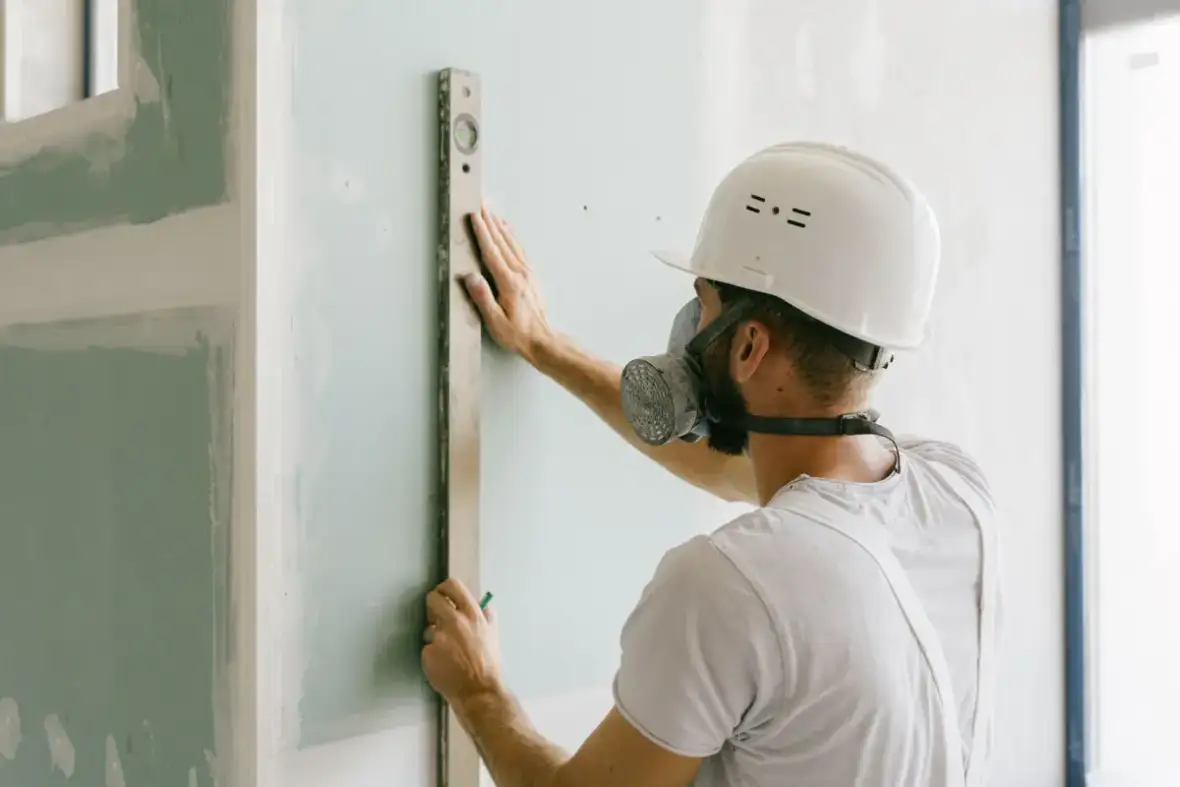
The single most consequential fact about working in Greendale. The 366 original homes were built with concrete block walls plastered on the inside, so there is no cavity, no lath, and no framing member to fasten into. Repairing that plaster is a masonry-substrate plaster job rather than a drywall job. Covering it with board requires furring strips fastened into the block first, both to create something to screw to and to establish a flat plane the block does not provide on its own.
Furring Out Block Walls, and What It Costs You
Where boarding over block is the right answer, furring comes first and it is real labor that a square-foot rate does not capture. It also has a consequence specific to Greendale: these houses were built to a tight federal budget with modest room dimensions, so furring out a wall and adding board takes interior space that was not generous to begin with. Jambs, outlets and trim all need extending too. It is often the right call. It is never the cheap one, and a quote that hides it is not quoting the real job.
Later Additions Meeting Original Block
Most of the original homes have been added to or altered over eighty-odd years, which produces the hardest junction in the village: a stud-framed, board-finished addition meeting a plastered block wall. Two entirely different assemblies, different thicknesses, different responses to a humidity swing. Taping that as an ordinary seam produces a line and then a crack. It gets shimmed level and skimmed across a wide band so the transition is gradual rather than a joint.
Newer Greendale Housing
The village grew well beyond its original 366 homes, and the later housing is conventional stud framing with board — normal work with normal failures. The practical point is that Greendale contains two completely different construction types, and which one an address falls into is the first thing to establish rather than something to discover partway through a job.
Southridge and Village Center Retail Interiors
Southridge Mall opened in 1970 and the Village Center was remade in 1996, so the commercial side of Greendale runs on tenant cycles rather than on the village's historic fabric. That work is partition changes, patched anchor points, and finishes brought back to a lease date, coordinated around electrical, mechanical and fire-suppression rough-in.
Where This Comes Up Around Greendale, WI
The Alphabetical Street Sections
The original village core was laid out in lettered sections, with every street inside a section beginning with the same letter. It is a quick way to tell whether an address sits in the 1930s federal core or in the later development around it, which is the distinction that decides the method.
National Historic Landmark Status
The Greendale Historic District was National Register-listed in 2005 and designated a National Historic Landmark in 2012. Those designations chiefly govern exterior and federally funded work, so interior repair is generally the owner's call — but exterior changes are a conversation with the village before they are a conversation with a contractor.
When We’re Not the Right Call
- A single nail hole, or a hairline crack you can cover with your thumb. That is a patch kit and an afternoon, and nobody should bill a trip across the metro for it. If it turns out to be bigger than it looks once you open it, that is drywall repair.
- Walls that are still wet. Board hung against a cavity that has not dried through will be off the wall inside a year, so the source gets fixed and the drying gets verified first — even when that pushes the start date back a week.
- Framing that has not passed inspection. No professional should close a wall ahead of the inspector, and every municipality out here runs its own building department with its own schedule.
- Anyone who wants a firm number over the phone. Around Milwaukee the wall behind the paint might be plaster over wood lath, plaster over rock lath, board over old plaster, or plaster straight onto concrete block. Those are four different jobs, and a price quoted sight-unseen is a guess with a dollar sign on it.
- Addresses outside Milwaukee County and the neighboring Waukesha, Ozaukee and Washington County suburbs.
Frequently Asked Questions
- Do you serve Greendale, WI?
- Yes. Greendale is about 8.1 miles south-southwest of Milwaukee and is inside the regular coverage area.
- Why can't you just screw drywall to my Greendale wall?
- Because in the original village homes there is nothing to screw into. Those 366 houses were built with concrete block walls plastered directly on the inside, so there is no stud cavity and no lath. Fasteners need a furring layer attached to the block first, which also gives you the flat plane the block does not have on its own. It is a genuine extra step, not an upsell, and it should appear as its own line on an estimate.
- Does National Historic Landmark status stop me repairing my walls?
- Generally not on the inside. National Register listing and Landmark designation chiefly govern exterior work and federally funded projects, so interior repair and finishing is usually the owner's decision. Exterior changes are a different matter and are worth raising with the Village of Greendale before planning anything. Confirm the specifics for your address rather than relying on a general answer.
- How do I know if my house is one of the original 366?
- The street name is a good first clue — the original core was laid out in lettered sections where every street in a section starts with the same letter. Beyond that, the construction tells you: a solid, unusually cold-feeling wall that sounds dead rather than hollow when tapped is block rather than framing. The village can confirm the build date for a specific address.
- What does drywall work cost in Greendale?
- It splits into two answers, which is unusual. Later Greendale housing prices like anywhere else — square footage, ceiling height, finish level, access. The original village homes carry furring labor before any board goes up, and that is a substantial line item rather than a rounding error. Anyone quoting an original Greendale home at a standard per-square-foot rate has not looked at the wall.
Learn More
- Gypsum Association GA-214 — the published definition of drywall finish levels 0 through 5
- City of Milwaukee Development Center — local permitting and inspection requirements for residential construction
- Wisconsin DSPS Uniform Dwelling Code — the state code governing one- and two-family dwelling construction
Need Drywall Installation in Greendale, WI?
Tell us what’s going on and get an immediate on-site quote — no charge for the estimate, and no obligation to book it.
Get My Free Estimate